Crisis at the Dam des Mousseaux: problems and solutions
FEBRUARY 2025
STOP PRESS:
REUNION SUR LE BARRAGE
le 26 fevrier, 19.00 h
Salle Publique a Meon
Reunion Publique
Pour plus des renseignements contactez Mairie de Breil.
0241 825518
The Problems Created by the Resurgence at the Foot of the Dam: September 2021 to Present
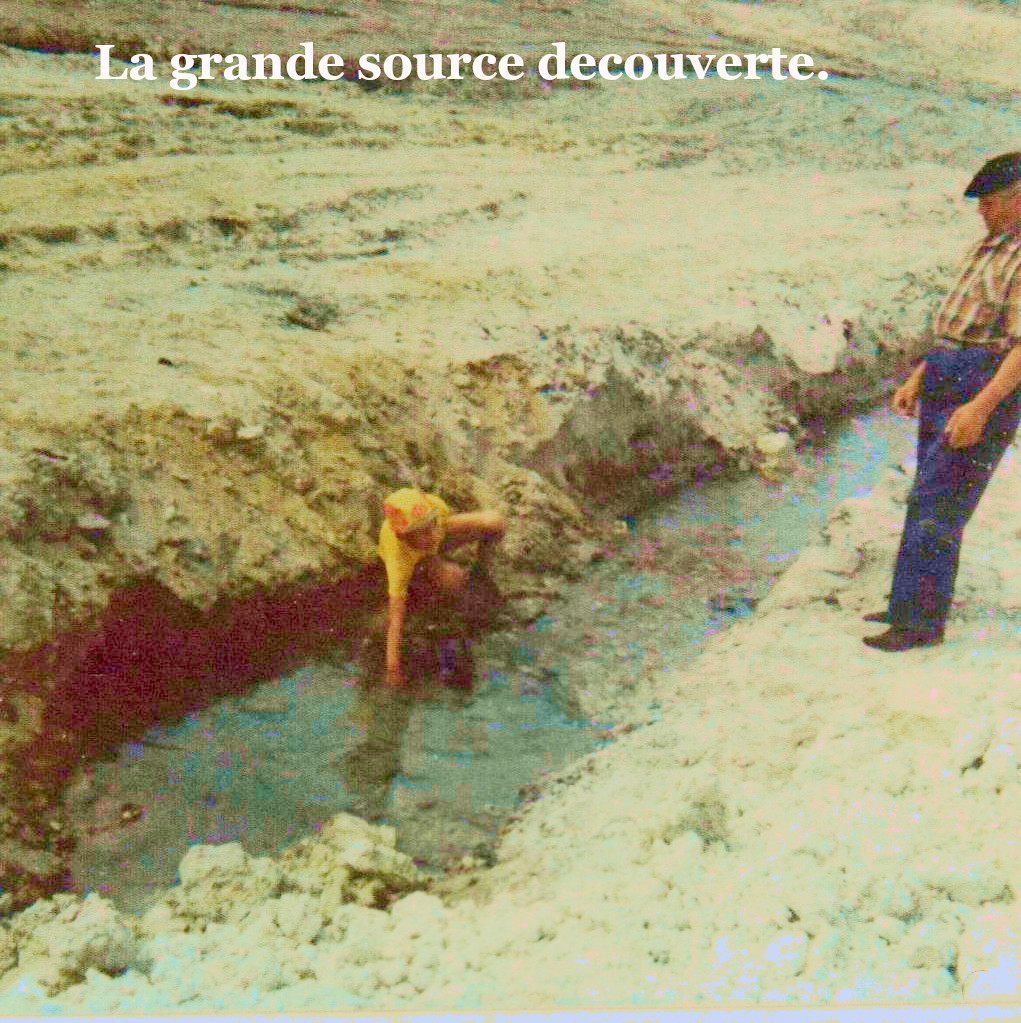
Around 13th September 2021 a resurgence or spring suddenly appeared at the downstream foot of the dam. This was notified by SYDEVA (Syndicat pour le developpement de l'Authion) on 20 September 2021 and also to the Direction Regionale de l'Environnement de l'Amenagement de du Logement (DREAL) of the Pays de la Loire as it presented a potential danger.
But the springs were suppressed by the construction and have presented few problems in the past 50 years, other than in the ground being very humid. Excess water is mostly carried away in the canal which takes the water back to the Lathan after the diversoire.
But around 13th September, 2021, when a piezometric borehole was drilled at the foot of the dam as part of investigations recommended by an approved consultancy firm, the drilling caused a resurgence of pressurised groundwater which rose to the surface. The finding in September 2021 was that the water that came out was clear and free of fine particles, which meant it was not causing any noticeable erosion of the dam's interior.
On 9th June 2022 SYDEVA was asked to submit a preliminary project for reinforcing the dam by 30 September 2022 and to submit a project by 31 March 2023, requesting that the resurgence be dealt with within 3 months. This was later revised to 30th Jue 2024 following the cancellation of the first project contract and an inspection by DREAL on 12th December 2023.
The launch of the second contract was delayed by the need to treat the resurgence as a matter of urgency as the transport of fine particulate matter had now been observed in the spring water since March 2024.
Fine Particles
The study steering committee meeting of the 2nd April 2024, reported that there had been a worsening of the resurgence, with the appearance of fine particles in the water discharged and a flow rate that has
increased since the winter of 2024. At the time, the design office was working on a solution to fill the borehole with resin.
However, there were fears that the techniques proposed had never been used before and potentially that if it was unsuccessful, the situation would be worse than before. SYDEVA stated that the leakage rate was constant at around 8.5 m3/h; and that the water was still laden with “fines”, and with sandy materials most likely originating from the
foundation of the dam.
A study steering committee on 6th June 2024 proposed :
a first phase of emergency works including the construction of of an access track to the said resurgence, the removal of the concrete base and the capping of the existing piezometer, with a drainage filter, a system for collecting the water and conveying it to atreatment plant; and to a collection manhole and then to a device for measuring water flow rates and water quality and fine particles;
a second phase of emergency work involving the complete restoration of the resurgence
The work started in September 2024 to take advantage of the low-water level of the dam reservoir and the water table,
necessary for the work to be carried out properly, thanks to the lower water pressure in the resurgence at this time of year.
January 2025
This is what happens when earth dams breach. Let's hope it never occurs here!
The Importance of the Work
Without the work, the dam does represent a considerable risk to people downstream in the event of failure.
The water and fines emanating from the resurgence may, if not controlled by the first phase of emergency works, cause a rupture of the foundation soil likely to generate untimely releases of water without it being possible to intervene to stop them, and that this situation is likely to degenerate into a breach in the dam.
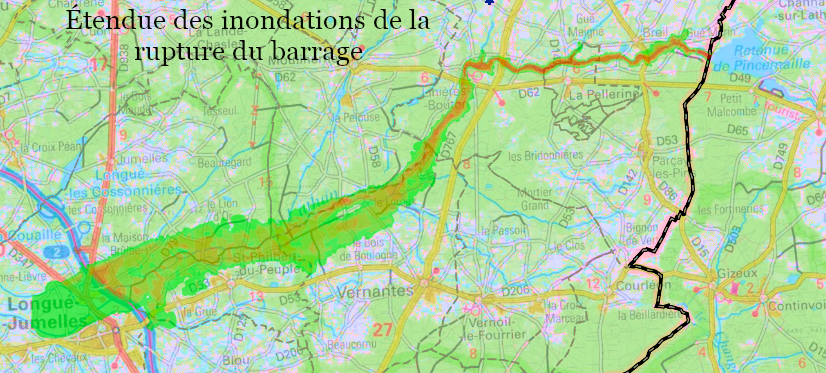
According to the most recent hazard study on the dam, in the event of a full-load failure, the failure wave would affect the entire dam, including the reservoir. and the rupture wave would affect around 605 buildings and 1,278 people, including 70 who would be rapidly exposed in Breil (less than 45 minutes), and including 2 schools in Longué-Jumelles.
It was concluded that if the migration of fine materials has not been controlled after 21 June 2024, despite the first
of the work, SYDEVA, as the legal manager of the Rillé dam, would proceed immediately to conduct an emergency draining of the Rillé dam, by lowering the water level by 1 m per week, or failing that, opening the dam gates completely, from the day on which the presence of fines in the water collected downstream of the temporary works is observed or completely stopped, or until the dam is completely emptied.
Currently although the resurgence itself has not been suppressed, the current actions have meant that fine particles are not at present observed. Accordingly, the water level of the dam will be drained in accordance with the normal operation of the dam and the studies continue, with possibly a future ‘vidange’ of the lake next year or soon after, so other remedial works can be done and the condition of the dam and surrounding structures can be examined.
A meeting is to be held for local people in Noyant in February. (Give details here when known)
IMAGES
Post dam breach map
The latest disaster analysis showed that a huge area would be affected within a short while after a breach of the dam
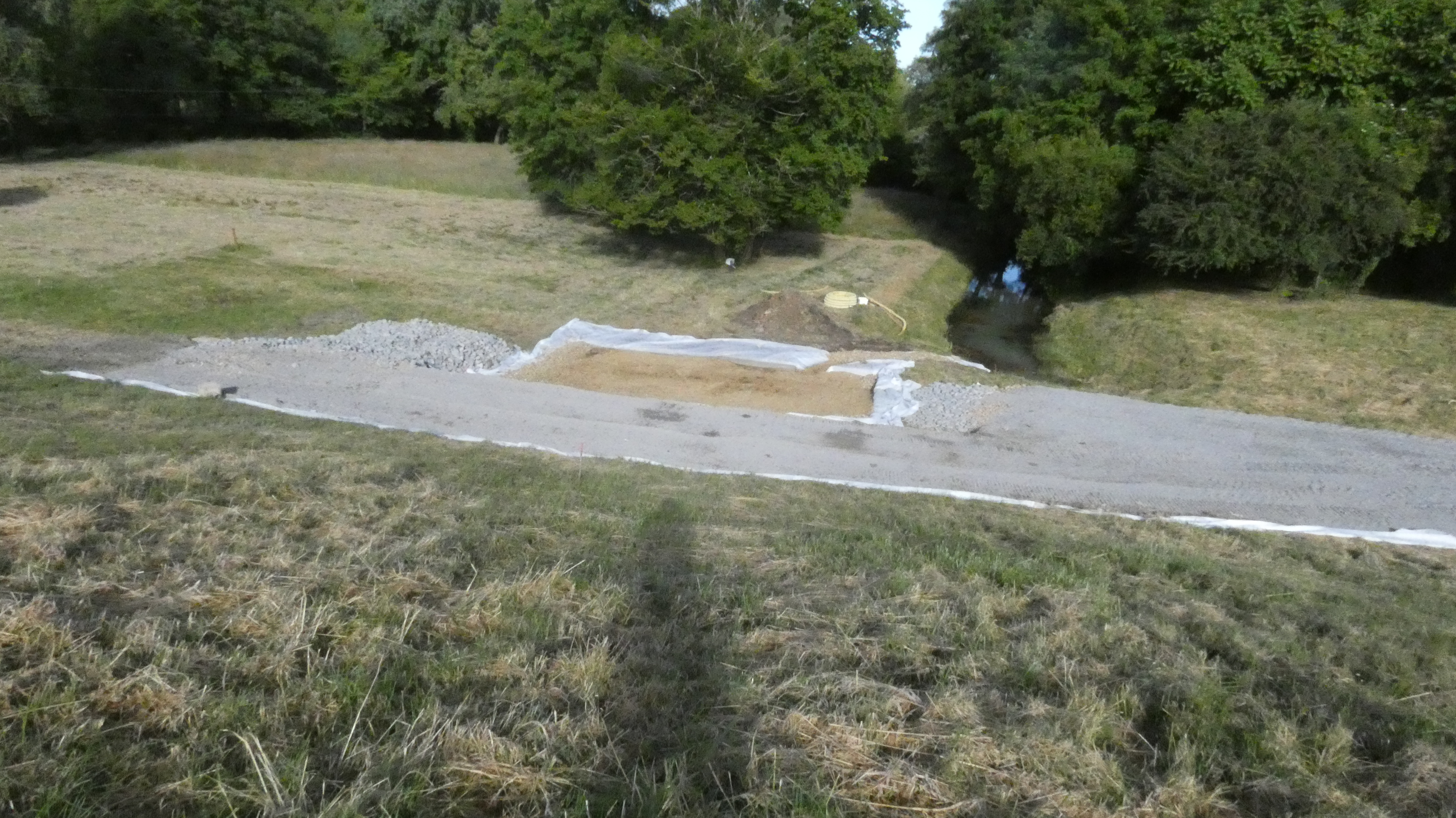
Gravel Bed to Suppress Resurgence
Although the new gravel bed with membranes and other structures has not repressed the spring, the water currently is free from fine particles reducing past concerns
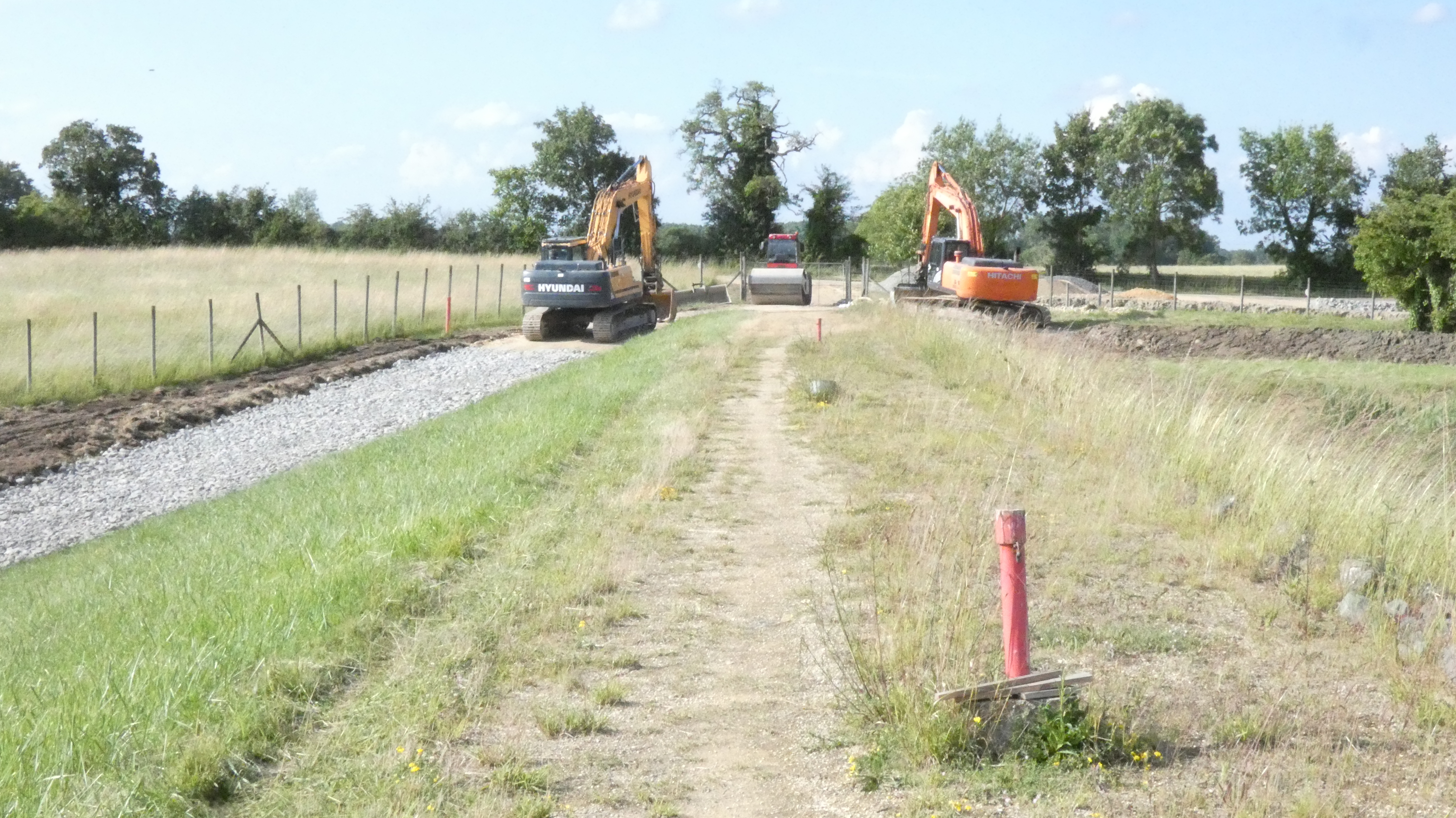
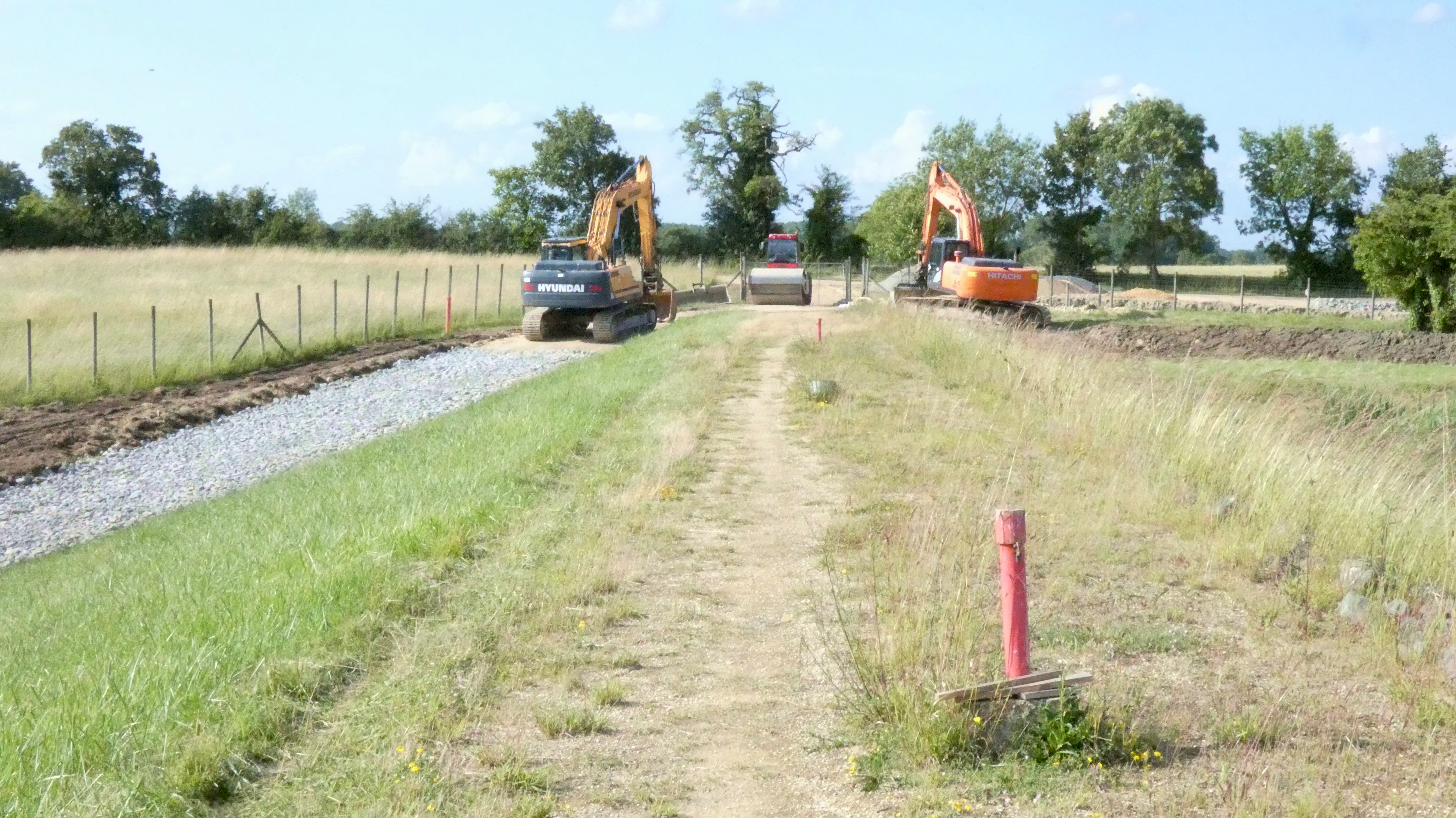
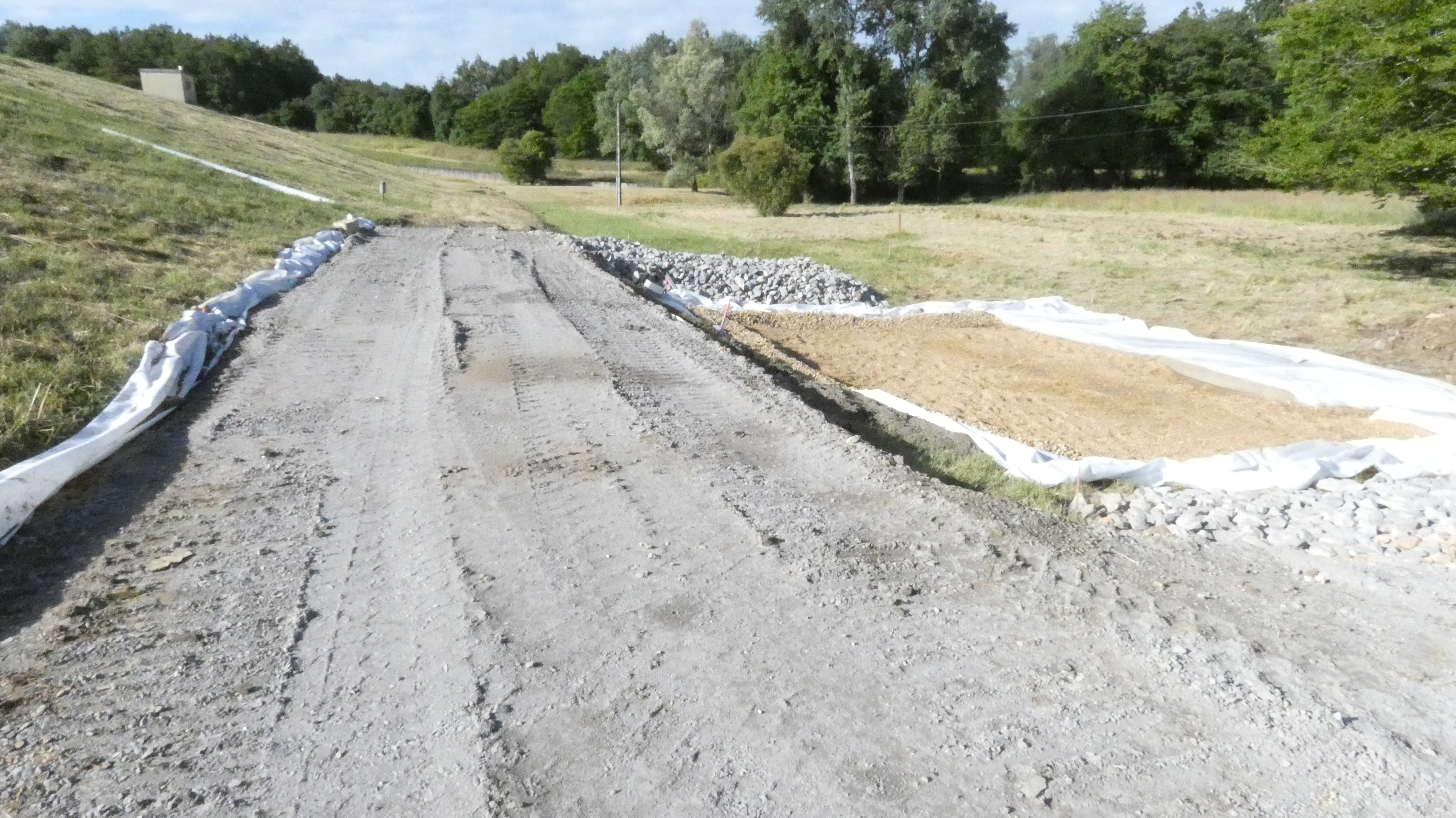
The New Access Road
The new road was built across the face of the dam and to the foot at the downward side. This means heavy machinery can now easily access for remedial work
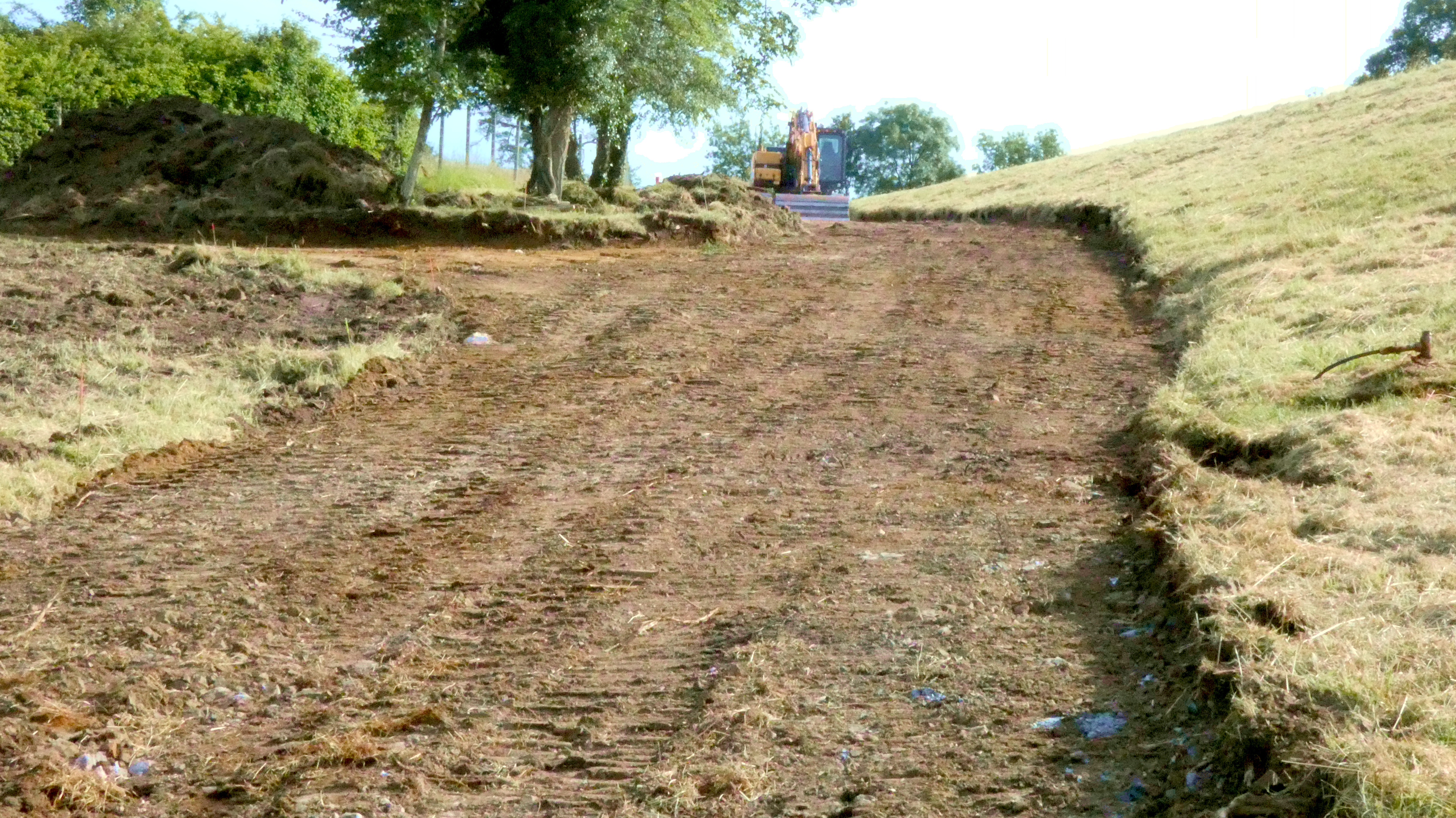
Initial Road Work
There was substantial work involved in created a foundation for the new road for heavy machines across the front of the dam
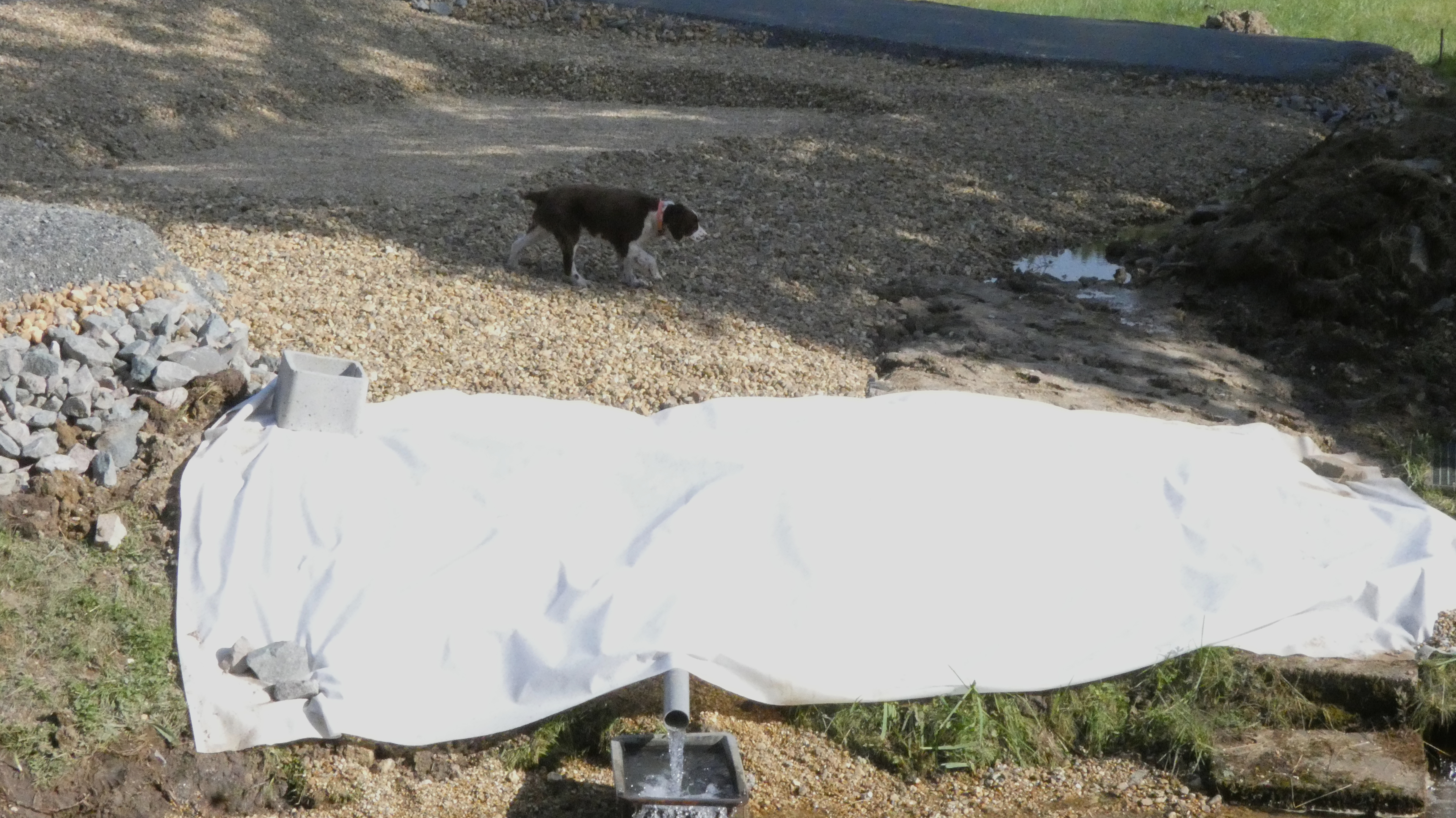
Large membranes suppress particles present in the spring water
New membranes are designed to suppress fine particles present in the spring or resurgence water. This should prevent the particles being removed from the structure of the dam eventually weakening it.
New gravel bed at the foot of the dam
The gravel bed surrounded by the road way is where a new well has been placed to suppress the flow and control the emerging water.
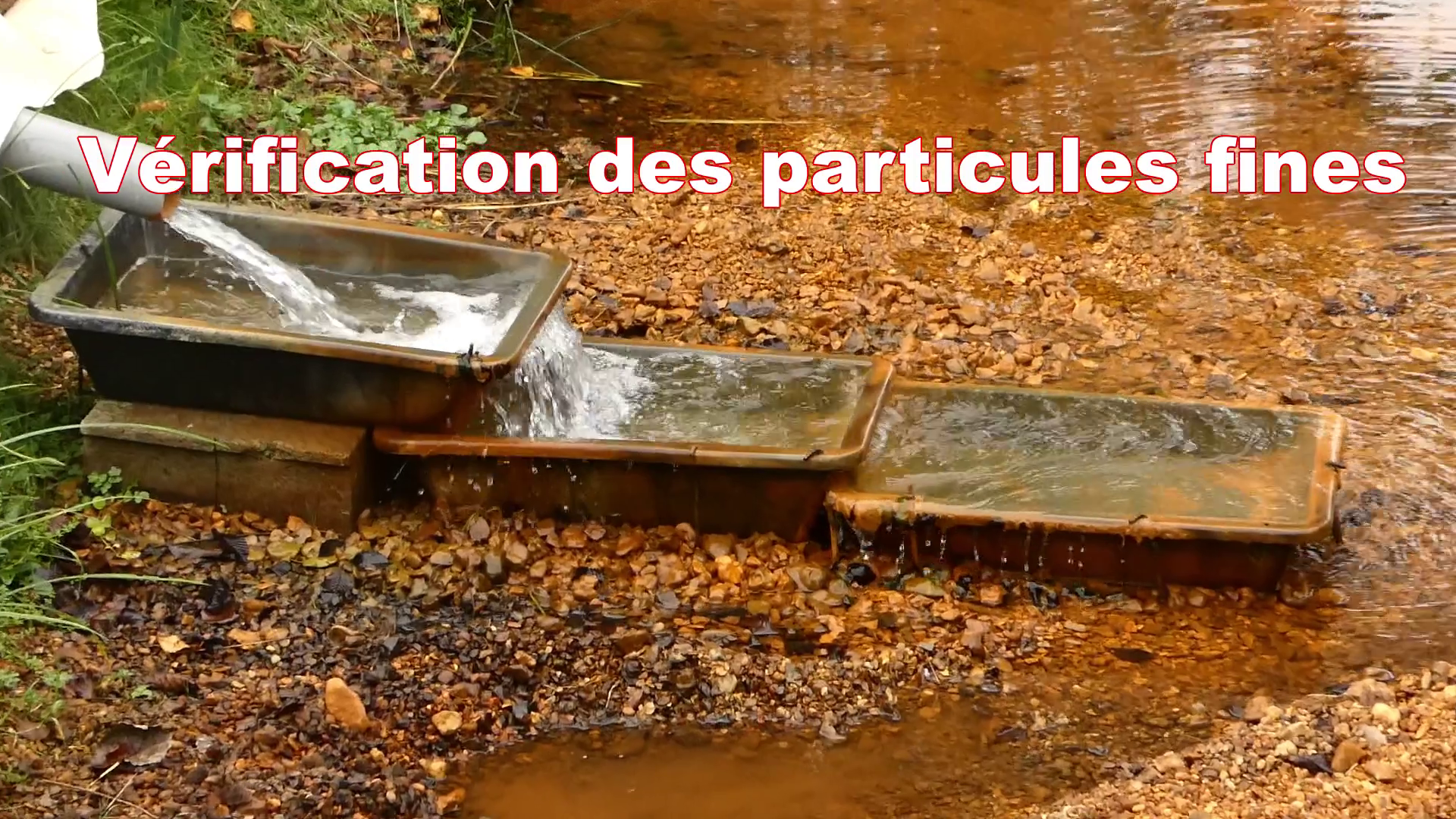
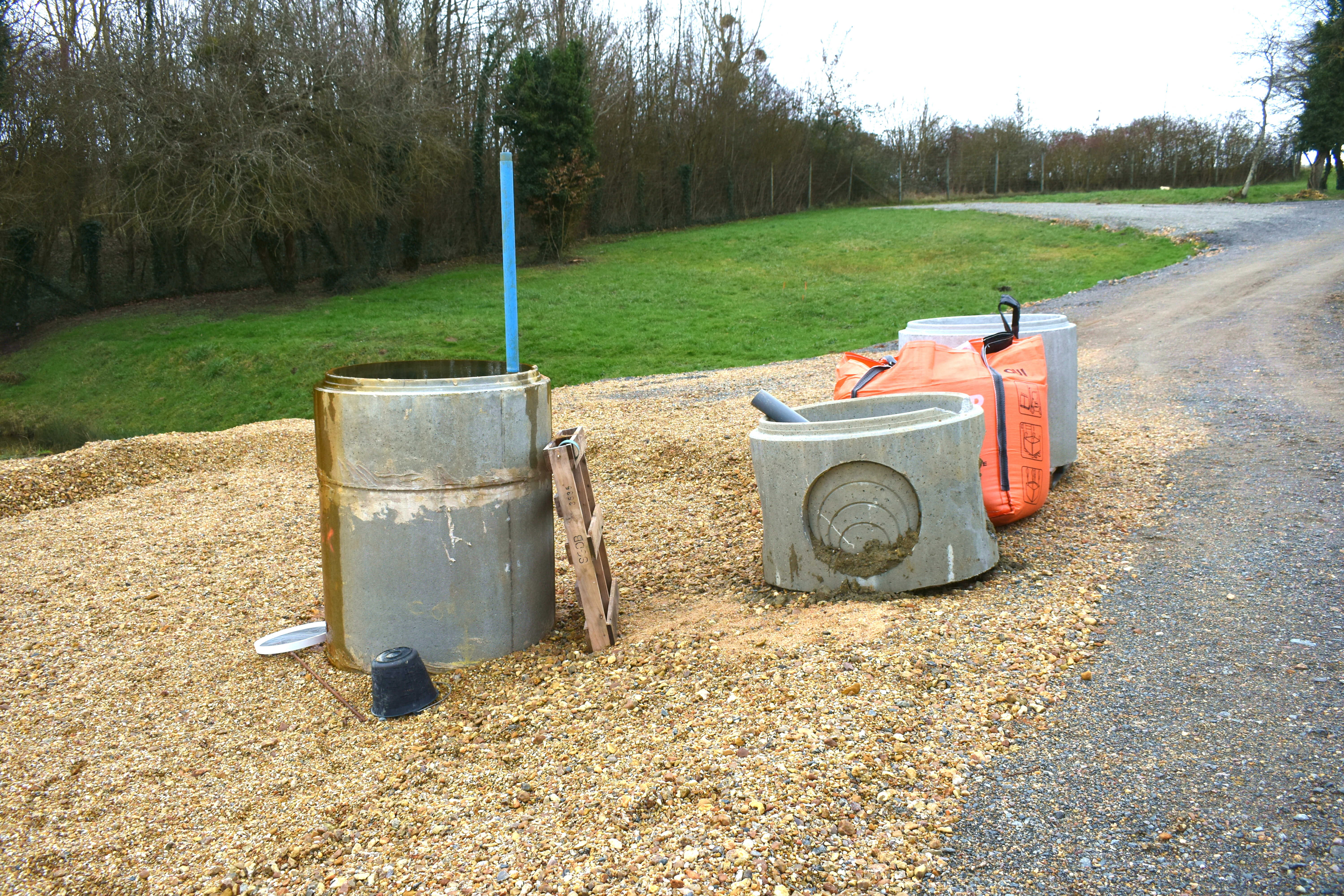
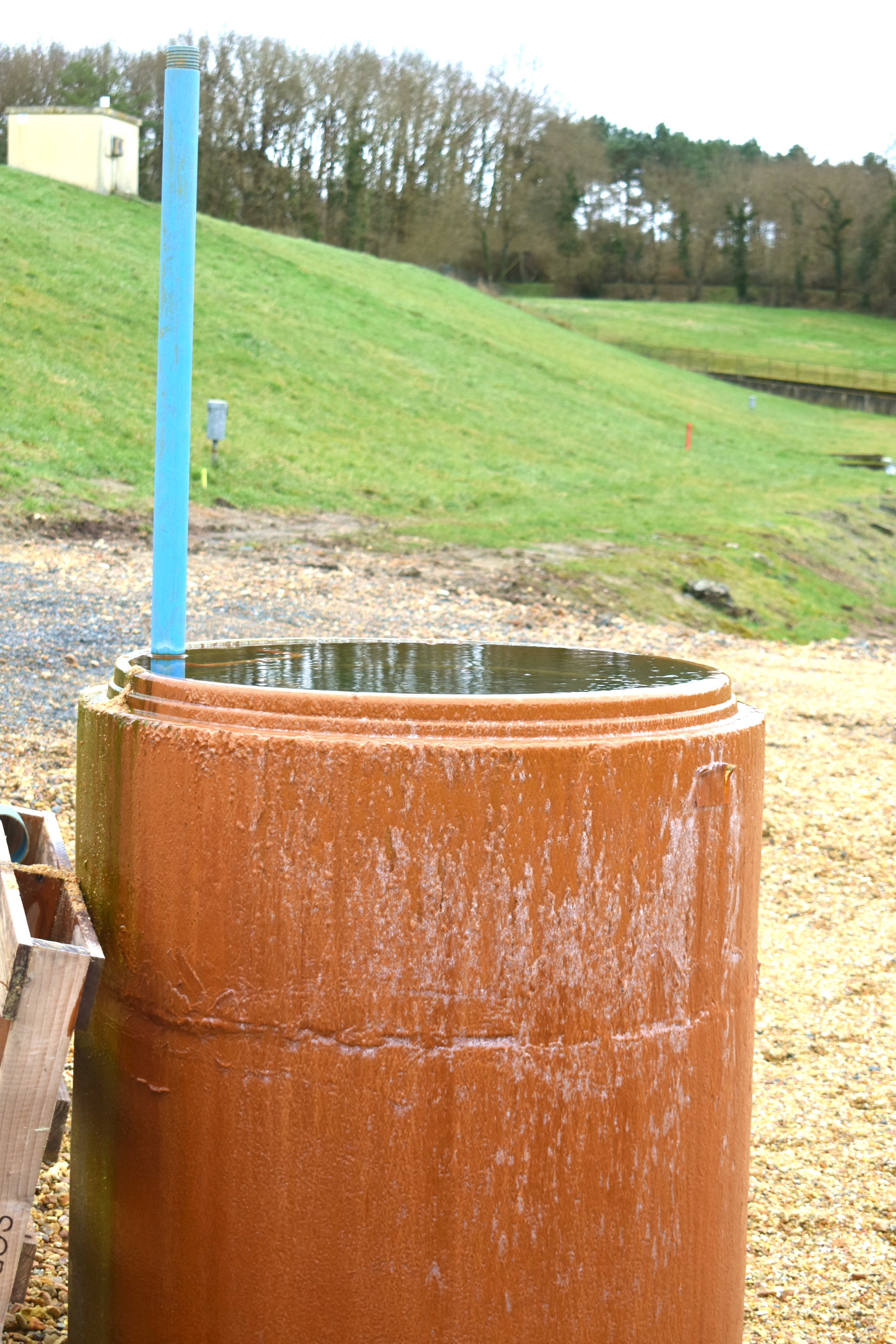
Latest equipment to measure resurgence outlet
A new well is installed into which the spring water rises and this enables regular monitoring for fine particulates. It is full to the brim
The new well with resurgence outlet in which spring water rises
A new well is installed into which the spring water rises and this enables regular monitoring for fine particulates. It is full to the brim. The water is warm
FRANCAIS
Les problèmes créés par la résurgence au pied du barrage : septembre 2021 à aujourd’hui
Vers le 13 septembre 2021, une résurgence ou source est soudainement apparue au pied aval du barrage. Cela a été notifié par le SYDEVA (Syndicat pour le développement de l'Authion) le 20 septembre 2021 ainsi qu'à la Direction Régionale de l'Environnement de l'Aménagement du Logement (DREAL) des Pays de la Loire car cela présentait un potentiel danger.
La présence de sources le long de la ligne du barrage était connue depuis sa construction en 1977
Mais les sources ont été supprimées par la construction et ont présenté peu de problèmes au cours des 50 dernières années, si ce n'est le sol très humide. L'excès d'eau est en grande partie emporté dans le canal qui ramène l'eau au Lathan après le diversoire.
Mais vers le 13 septembre 2021, lorsqu'un forage piézométrique a été réalisé au pied du barrage dans le cadre d'investigations recommandées par un bureau d'études agréé, le forage a provoqué une résurgence d'eau souterraine sous pression qui est remontée à la surface. Le constat de septembre 2021 était que l'eau qui en sortait était claire et exempte de fines particules, ce qui signifie qu'elle ne provoquait aucune érosion notable de l'intérieur du barrage.
Le 9 juin 2022, SYDEVA a été invitée à déposer un avant-projet de renforcement du barrage avant le 30 septembre 2022 et à déposer un projet avant le 31 mars 2023, en demandant que la résurgence soit traitée dans un délai de 3 mois. Celui-ci a ensuite été révisé au 30 juillet 2024 suite à l'annulation du premier contrat de projet et à une inspection de la DREAL le 12 décembre 2023.
Le lancement du deuxième contrat a été retardé par la nécessité de traiter en urgence la résurgence
car le transport de particules fines était désormais observé dans l’eau de source depuis mars 2024.
Le comité de pilotage de l'étude du 2 avril 2024, a constaté une aggravation de la résurgence, avec l'apparition de particules fines dans les eaux rejetées et un débit qui a diminué.
augmenté depuis l’hiver 2024. A l’époque, le bureau d’études travaillait sur une solution pour remplir le forage avec de la résine.
On craignait cependant que les techniques proposées n’aient jamais été utilisées auparavant et qu’en cas d’échec, la situation ne soit pire qu’avant. Le SYDEVA indique que le débit de fuite est constant, autour de 8,5 m3/h ; et que l'eau était encore chargée de « fines », et de matières sableuses provenant très probablement du fondation du barrage.
Un comité de pilotage de l'étude du 6 juin 2024 a proposé :
• une première phase de travaux d'urgence comprenant la construction d'une piste d'accès à ladite résurgence, la dépose du socle en béton et le recouvrement du piézomètre existant, avec un filtre drainant, un système de collecte des eaux et leur acheminement vers un centre de traitement. usine; et à un regard de collecte puis à un dispositif de mesure des débits d'eau et de la qualité de l'eau et des particules fines ;
• une deuxième phase de travaux d'urgence impliquant la restauration complète de la résurgence
Les travaux ont débuté en septembre 2024 pour profiter du faible niveau d'eau du réservoir du barrage et de la nappe phréatique,
nécessaires au bon déroulement des travaux, grâce à la pression d'eau plus faible dans la résurgence à cette période de l'année.
L'importance du travail
Sans ces travaux, le barrage représente un risque considérable pour les populations en aval en cas de rupture.
Les eaux et fines émanant de la résurgence peuvent, si elles ne sont pas maîtrisées par la première phase des travaux d'urgence, provoquer une rupture du sol de fondation susceptible de générer des rejets intempestifs d'eau sans qu'il soit possible d'intervenir pour les stopper, et que cette situation est susceptible de dégénérer en brèche dans le barrage.
Selon la plus récente étude de danger sur le barrage, en cas de rupture à pleine charge, la vague de rupture affecterait l'ensemble du barrage, y compris le réservoir. et la vague de rupture toucherait environ 605 bâtiments et 1 278 personnes, dont 70 qui seraient rapidement exposées à Breil (moins de 45 minutes), et dont 2 écoles à Longué-Jumelles.
Il a été conclu que si la migration des matières fines n'a pas été maîtrisée après le 21 juin 2024, malgré les premiers des travaux, SYDEVA, en tant que gestionnaire légal du barrage de Rillé, procéderait immédiatement à une vidange d'urgence du barrage de Rillé, en abaissant le niveau d'eau de 1 m par semaine, ou à défaut, en ouvrant complètement les vannes du barrage, de le jour où la présence de fines dans les eaux captées en aval des ouvrages temporaires est constatée ou complètement arrêtée, ou jusqu'à la vidange complète du barrage.
Actuellement, même si la résurgence elle-même n'a pas été supprimée, les actions actuelles font que les particules fines ne sont pas observées pour le moment. En conséquence, le niveau d'eau du barrage sera drainé conformément au fonctionnement normal du barrage et les études se poursuivront, avec éventuellement un futur 'vidange' du lac l'année prochaine ou peu après, afin que d'autres travaux de réparation puissent être effectués et que le L'état du barrage et des structures environnantes peut être examiné.
Une réunion des populations est prévue à Noyant en février.
REUNION SUR LE BARRAGE
le 26 fevrier, 19.00 h
Salle Publique a Meon
Reunion Publique
Pour plus des renseignements contactez Mairie de Breil.